
earch for an AKG supplement and you'll find at least four different versions sitting side by side, sodium-AKG, calcium-AKG, arginine-AKG, ornithine-AKG, all listed as though they do the same thing. They don't. The compound at the centre is identical. What's bonded to it changes how stable it is, how it behaves once swallowed, and, crucially, which body of research it can actually claim.
This matters more than it sounds. The studies that made Ca-AKG supplement searches spike, a mouse lifespan trial and a human biological age study, both used one specific form: calcium alpha-ketoglutarate. Not free AKG. Not arginine-AKG. The calcium salt, specifically.
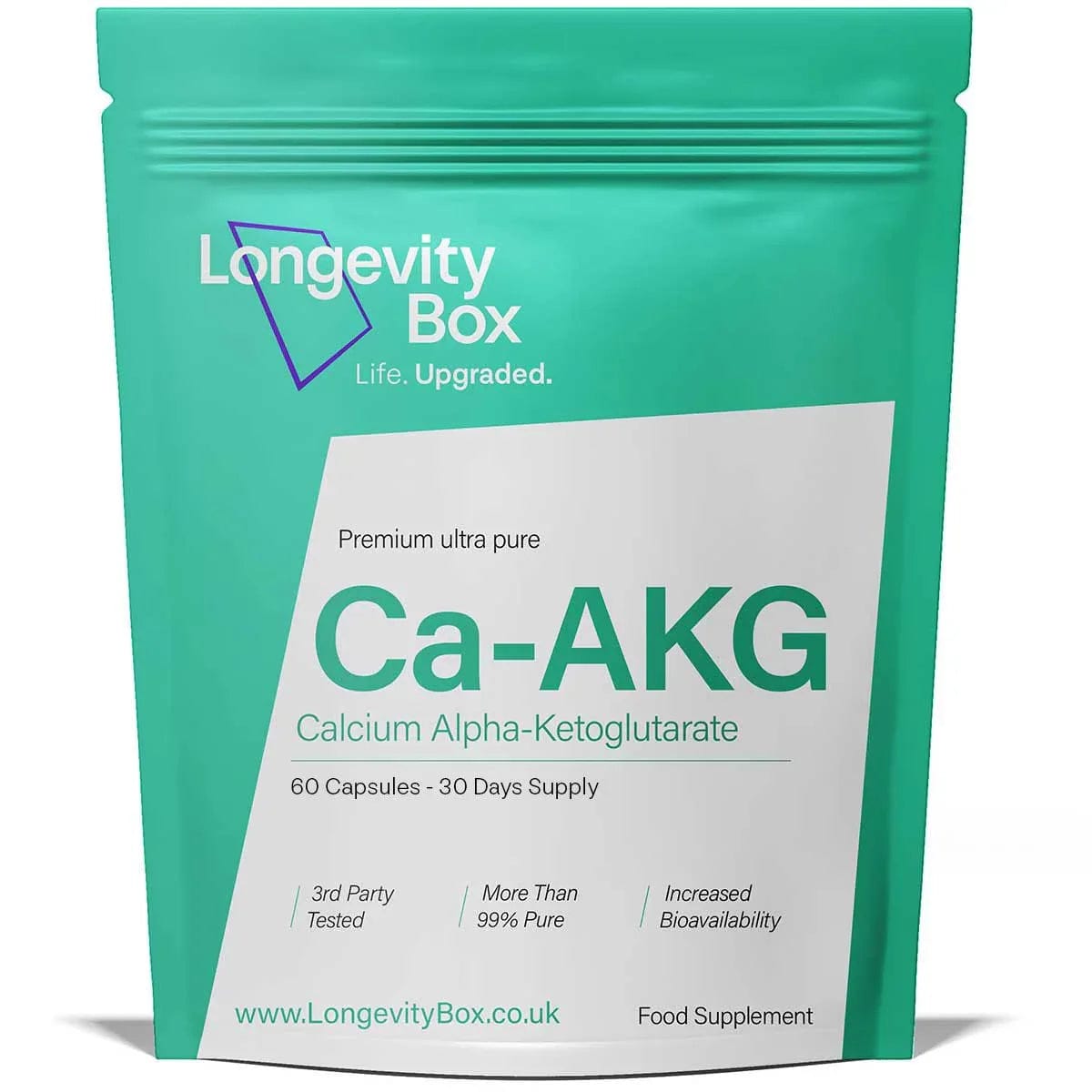
This guide breaks down why that distinction exists, what the calcium actually does chemically, and how to tell the difference when comparing products. Longevity Box's Pure Calcium Alpha-Ketoglutarate is formulated to match the form used in this research, delivered as a clean, unblended powder with nothing else added.
Key Takeaways
-
Alpha-ketoglutarate forms aren't interchangeable. AKG is typically sold as sodium-AKG, calcium-AKG (Ca-AKG), arginine-AKG (AAKG), or ornithine-AKG (OKG), and each one exists for a genuinely different reason.
-
The landmark 2020 mouse study that put AKG on the longevity map, published in Cell Metabolism, specifically used the calcium salt, not free AKG or another form, and found a roughly 12% average lifespan extension alongside a striking 40%+ improvement in healthspan markers.
-
A 2021 human study using a 1-gram Ca-AKG supplement measured an average biological age reduction of 8 years by DNA methylation clocks, again using the calcium-bound form specifically.
-
Free AKG is chemically unstable and rapidly degrades. Binding it to calcium significantly improves its stability, slows its absorption, and extends how long it stays biologically active in the bloodstream.
-
Arginine-AKG serves an entirely different purpose. It's built for nitric oxide and blood flow support in sports performance, not the longevity pathway research behind Ca-AKG.
-
When comparing best AKG supplements, checking which form is actually inside the capsule matters more than the marketing on the front of the bottle, since "AKG" alone doesn't tell you which research applies.
-
Longevity Box's Pure Calcium Alpha-Ketoglutarate delivers a high-purity, unblended 1000mg daily serving, matching the specific form used in the research this category is built on.
What Is Alpha-Ketoglutarate, and Why Does the "Salt" Matter?
Alpha-ketoglutarate is a natural metabolite your body produces as part of the Krebs cycle, the core process cells use to generate energy, but on its own it's chemically unstable, which is exactly why supplement forms bind it to something else.
AKG levels decline substantially with age, dropping roughly tenfold between the ages of 40 and 80. That decline is part of what's driven interest in supplementing it directly. The catch is that free, unbound AKG is a charged molecule that struggles to cross cell membranes efficiently and breaks down quickly once exposed to moisture, heat, or stomach acid.
Binding AKG to a mineral or amino acid, forming what chemists call a "salt," solves this instability. It's the same basic principle behind why magnesium is often sold as magnesium citrate or magnesium glycinate rather than pure elemental magnesium. The salt form isn't just packaging. It changes how the compound behaves inside the body.
What Are the Main Alpha-Ketoglutarate Forms Available?
AKG is commercially produced in several bound forms, and research shows they're studied for meaningfully different purposes, not as interchangeable versions of the same product.
|
Form |
What It's Bound To |
What It's Primarily Studied For |
|
Ca-AKG (Calcium AKG) |
Calcium |
Longevity, healthspan, biological age, bone support |
|
Na-AKG (Sodium AKG) |
Sodium |
General metabolic research, less commonly used in longevity studies |
|
AAKG (Arginine AKG) |
Arginine |
Sports performance, nitric oxide production, blood flow |
|
OKG (Ornithine AKG) |
Ornithine |
Clinical nutrition, wound healing, muscle protein metabolism |
Seeing "AKG" on a label doesn't tell you which of these you're actually getting, or which research applies. The bound form is the detail that decides that, and it's often only visible in the small print or the full ingredient name.
Why Did the Landmark Longevity Research Specifically Use Ca-AKG?
Researchers chose the calcium salt specifically because of its chemical stability and slow-release absorption profile, not arbitrarily, and this choice is documented directly in the published methodology.
The two studies that built this category's reputation both specify the calcium form:
-
The 2020 mouse study (Cell Metabolism). Researchers fed C57BL/6 mice a diet supplemented specifically with CaAKG starting at 18 months of age. Results showed an average lifespan extension of roughly 12%, alongside a healthspan improvement, measured by a clinically relevant frailty index, of more than 40%. The study's authors explicitly note the AKG was "delivered in the form of a calcium salt."
-
The 2021 human study (Demidenko et al.). Using a 1-gram Ca-AKG tablet, researchers measured an average biological age reduction of 8 years via DNA methylation clocks, 6.98 years in women and 8.44 years in men.
Follow-up research examining why the calcium form was selected points to a clear mechanistic reason: Ca-AKG is acidic and absorbed more slowly through the gastrointestinal tract than free AKG, producing a gradual, sustained release into the bloodstream rather than a quick spike and drop. That sustained profile is thought to be part of why its biological effects hold up over a longer period.
Ca-AKG vs AKG: What Does the Calcium Actually Change?
Comparing Ca-AKG vs AKG in its free, unbound form, the calcium bond provides three specific advantages: chemical stability, slower and more sustained absorption, and improved bioavailability.
Here's what changes when AKG is bound to calcium:
-
Stability. Free AKG degrades relatively quickly under normal storage conditions. Binding it to calcium significantly improves shelf stability, which matters for anything sitting in a capsule for months before use.
-
Absorption speed. Ca-AKG's slower gastrointestinal absorption produces a more gradual release into the bloodstream, rather than free AKG's faster, shorter-lived spike.
-
Bioavailability. Because AKG is a charged molecule with limited ability to cross cell membranes on its own, the calcium-bound form has been shown to improve how effectively it's actually taken up and used.
-
Added mineral benefit. As a calcium salt, Ca-AKG delivers a small amount of calcium alongside the AKG itself, which research has separately linked to supporting bone density, an added consideration for people specifically interested in ageing-related bone health.
None of this means free AKG is useless. It means the specific research underpinning most of the current interest in AKG as a longevity compound was conducted using the calcium-bound version, which is a meaningful distinction if you're choosing a supplement based on that research.
How Does Ca-AKG Compare to Arginine-AKG and Ornithine-AKG?
Arginine-AKG and ornithine-AKG are built around entirely different goals than Ca-AKG, and confusing the three often leads people to buy the wrong product for what they're actually trying to achieve.
-
Arginine-AKG (AAKG). This form pairs AKG with the amino acid arginine specifically because arginine boosts nitric oxide production, supporting blood flow and the "pump" effect associated with exercise performance. Research has shown AAKG enhancing endurance and reducing muscle breakdown in trained men, a sports-performance application, not a longevity one.
-
Ornithine-AKG (OKG). More commonly used in clinical nutrition settings, studied in contexts like wound healing, burns recovery, and muscle protein metabolism in medical populations, rather than general healthy-ageing supplementation.
-
Calcium-AKG (Ca-AKG). The form used in the specific mouse lifespan and human biological age studies referenced throughout this guide, chosen for its stability and sustained release rather than any performance-boosting secondary ingredient.
If your interest is in the longevity and healthspan research specifically, arginine-AKG and ornithine-AKG simply aren't the forms that research was conducted on. This is the most common point of confusion when people search for "AKG supplements" without realising how much the bound form changes what they're actually buying.
What Should You Look For in a Ca-AKG Supplement?
When comparing best AKG supplements, the calcium-bound form, a stated purity percentage, and independent testing matter more than marketing claims about "activated" or "next-generation" AKG.
A quick checklist before buying:
-
Confirm it's specifically calcium alpha-ketoglutarate, not just "AKG" or an unspecified salt form, since the research base only applies to the calcium-bound version.
-
Check for a stated purity percentage and third-party testing. A supplement without an accessible Certificate of Analysis makes it harder to verify what you're actually getting.
-
Look at the dose. The human research referenced above used roughly 1 gram of Ca-AKG, so check whether a product's per-serving dose is in a comparable, clinically relevant range rather than a token amount.
-
Check for unnecessary additions. Some products blend Ca-AKG with unrelated vitamins or proprietary blends, which can make it harder to isolate what's actually doing the work.
-
Compare price per effective gram, not just price per bottle, since serving sizes and capsule counts vary considerably between brands.
Longevity Box's Pure Calcium Alpha-Ketoglutarate is formulated as a clean, unblended powder, independently tested for purity, with a 1000mg daily serving delivered across two capsules and no added excipients diluting the dose.
Frequently Asked Questions
Is Ca-AKG the same thing as regular AKG?
No. Ca-AKG is alpha-ketoglutarate bound to calcium, which improves its stability and absorption profile compared to free, unbound AKG. The two behave differently once ingested, even though the core AKG molecule is identical.
Why did the longevity research use calcium AKG rather than another form?
Researchers selected the calcium salt specifically for its chemical stability and slower, more sustained absorption through the gastrointestinal tract. This delivery profile is thought to support the compound's biological effects over a longer window than free AKG would provide.
Can I use arginine-AKG instead of Ca-AKG for longevity purposes?
Not for the same research application. Arginine-AKG is formulated and studied primarily for sports performance and nitric oxide support, not the longevity and healthspan pathways that Ca-AKG research has focused on.
How much Ca-AKG did the human biological age study actually use?
The referenced study used a 1-gram Ca-AKG tablet, which measured an average biological age reduction of roughly 8 years across participants using DNA methylation clocks.
Does Longevity Box's Ca-AKG supplement match the dose used in research?
Yes. Our Pure Calcium Alpha-Ketoglutarate is formulated to deliver a full 1000mg daily serving, in line with the dosing referenced in the published human research on this compound.
Is Ca-AKG safe to take alongside other supplements or medication?
Ca-AKG is generally well tolerated, though mild gastrointestinal discomfort can occur at higher doses. Anyone taking prescription medication, managing an existing health condition, or who is pregnant or breastfeeding should speak with a healthcare professional before starting.
Why is calcium alpha-ketoglutarate sometimes more expensive than sodium AKG?
Calcium-bound formulations typically involve a more involved production process to achieve the stability and purity levels seen in the research, which is often reflected in cost compared to less-refined AKG forms.
