
Glutathione gets called the body's "master antioxidant" for good reason, but it's built from three amino acids, not one. Glutamate is usually plentiful. Glycine and cysteine are the two that tend to run short, particularly as we age. Supplementing just one of them is a bit like trying to bake with only two of three essential ingredients. The reaction that matters simply doesn't complete.
This is the entire logic behind a GlyNAC supplement: glycine and NAC (which supplies cysteine) taken together, at doses studied specifically to correct both shortfalls at once. It's a different proposition to buying glycine powder from one shop and NAC capsules from another and hoping the maths works out.
This guide breaks down why the combination matters, what ratio the actual research used, and whether taking glycine and NAC separately gets you anywhere close to the same result.
Key Takeaways
-
A GlyNAC supplement combines glycine and N-acetylcysteine (NAC) in one formulation, because both amino acids are needed together, at the same time, to drive glutathione synthesis, not because combining them is simply more convenient.
-
The Baylor College of Medicine trials that built GlyNAC's research reputation dosed glycine and NAC together on a body-weight basis, roughly 1.33 mmol/kg glycine to 0.81 mmol/kg NAC, a ratio favouring slightly more glycine than NAC.
-
Glycine and NAC together correct a genuine gap in older adults' biology. Research has shown that ageing lowers both amino acids simultaneously, so replacing only one leaves the glutathione pathway still short of what it needs.
-
A 24-week randomised trial in older adults found GlyNAC supplementation corrected red blood cell glutathione deficiency, cut oxidative stress markers by roughly 80%, and improved gait speed, grip strength, and cognition.
-
The NAC glycine ratio matters more than most people assume. Studies have tested both a roughly 1.6:1 weighted ratio and a simpler 1:1 gram ratio, and getting this balance wrong can under-supply one precursor relative to the other.
-
Taking a bottle of glycine and a separate bottle of NAC can work, but it puts the ratio and timing entirely on the person taking them, rather than delivering the balance used in the actual clinical research.
-
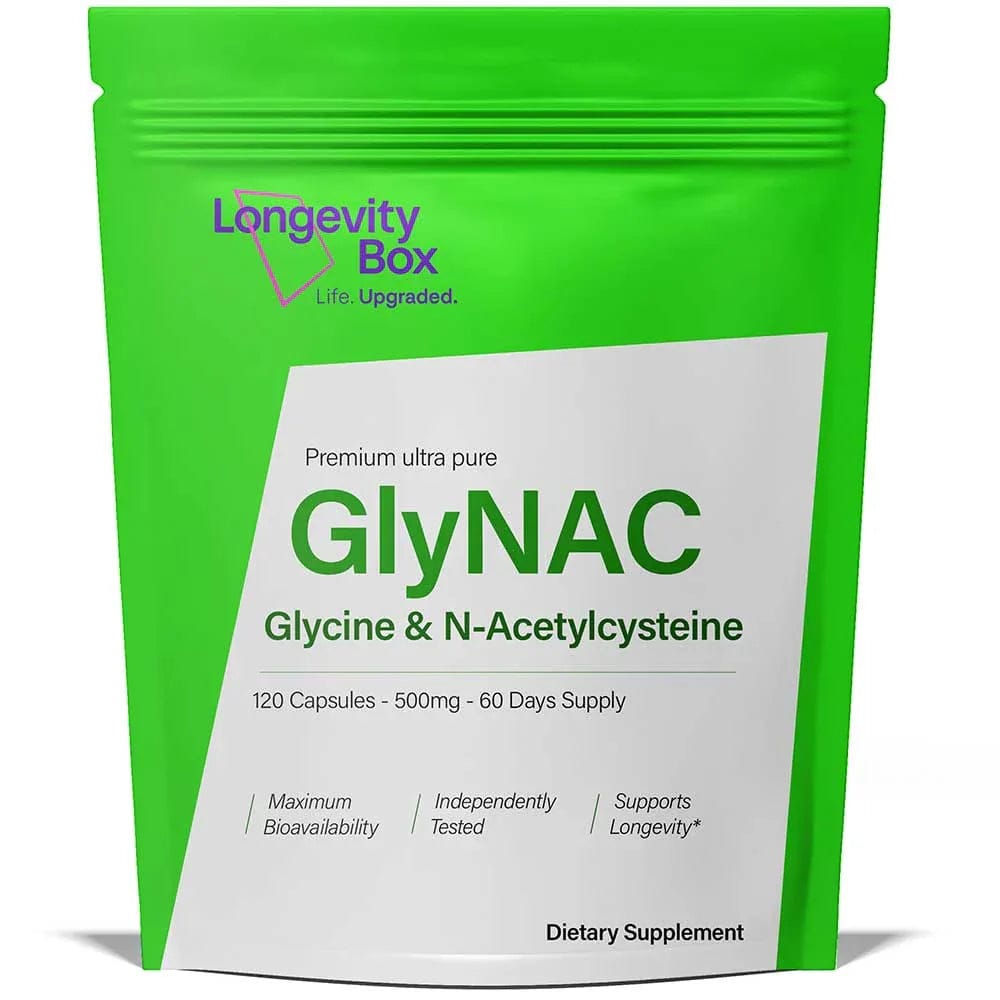
Longevity Box's GlyNAC formulation combines both amino acids as a glycine dietary supplement paired with NAC in one product, tested and dosed with the underlying research in mind.
What Is GlyNAC, and Why Combine These Two Amino Acids?
GlyNAC pairs glycine with N-acetylcysteine specifically because both are required, together, to synthesise glutathione, the antioxidant tripeptide your cells rely on to manage oxidative stress.
Glutathione is built from three components:
-
Glutamate, generally abundant and rarely a limiting factor
-
Cysteine, the rate-limiting precursor, supplied efficiently through NAC because cysteine itself is unstable and oxidises quickly
-
Glycine, long assumed to be plentiful since the body produces it naturally, but research has shown its production also declines with age
For years, cysteine was treated as the only bottleneck worth addressing. What Baylor College of Medicine's research group found was that glycine drops too, and correcting cysteine alone, without also correcting glycine, still leaves glutathione synthesis short. That finding is the entire reason GlyNAC exists as a combined formulation rather than a NAC-only supplement.
Why Glycine and NAC Together Matters More Than Either Alone
Supplementing only NAC or only glycine addresses half of a two-part deficiency, which is why research specifically tests the combination rather than either amino acid in isolation.
A few reasons the pairing matters:
-
Both precursors decline with age. Older adults in the Baylor trials showed measurably lower glutathione, alongside genuinely lower glycine and cysteine availability, compared to younger adults, not just one or the other.
-
Supplying only one precursor doesn't fix the pathway. If cysteine is corrected but glycine remains short, glutathione synthesis is still capped by whichever amino acid runs out first.
-
The research specifically tested the pair, not the parts. Every major GlyNAC trial to date has studied glycine and NAC given together, meaning the evidence base for benefits like improved mitochondrial function, reduced inflammation, and better physical function applies to the combination, not to glycine or NAC individually.
This is worth being clear-eyed about: NAC alone has its own separate research history, and glycine alone has genuine benefits around sleep and relaxation. But the specific ageing-related outcomes associated with "GlyNAC" come from studies of the two given together.
What Does the NAC Glycine Ratio Actually Need to Be?
Clinical research on GlyNAC has generally used a weighted ratio favouring somewhat more glycine than NAC, though the exact figure has varied slightly between trials.
Two approaches show up in the published literature:
|
Trial Type |
Dosing Approach |
Approximate Ratio |
|
Baylor pilot and follow-up trials |
Weight-based: 1.33 mmol/kg glycine, 0.81 mmol/kg NAC daily |
Roughly 1.6:1, glycine to NAC |
|
114-person healthy volunteer trial |
Fixed gram doses: 2.4g, 4.8g, or 7.2g total daily |
1:1 by weight |
Both approaches appear in credible, peer-reviewed research, so there isn't one single "official" ratio the entire field agrees on. What's consistent across all of it is that glycine and NAC are always dosed together, in a deliberate proportion, not as an afterthought. A supplement that provides a token amount of one relative to the other isn't reflecting either tested approach.
What Does Clinical Research Actually Show?
The most cited GlyNAC research comes from a series of Baylor College of Medicine trials in older adults, culminating in a 24-week randomised, placebo-controlled study with genuinely striking results.
Key findings from that 24-week trial:
-
Corrected glutathione deficiency. Red blood cell glutathione levels, significantly lower in older adults at baseline, returned to levels comparable to younger participants.
-
Reduced oxidative stress by roughly 80%, measured through markers like TBARS (thiobarbituric acid reactive substances).
-
Lowered inflammatory markers, including notable reductions in IL-6 and TNF-alpha.
-
Improved insulin resistance, with HOMA-IR scores dropping substantially.
-
Better physical function, including improved gait speed, grip strength, and a 19% improvement in a six-minute walk test.
-
Improved cognition and reduced genomic damage, alongside better body composition.
A follow-up 12-week withdrawal period, where supplementation stopped, showed many of these markers beginning to reverse, suggesting the benefits are tied to ongoing supplementation rather than a one-off correction. This is a meaningful detail: GlyNAC research points to a maintained routine, not a short course.
Can You Just Take Glycine and NAC Separately Instead?
Taking separate glycine and NAC supplements can theoretically deliver similar raw ingredients, but it shifts the entire burden of dosing, ratio, and consistency onto the person taking them, rather than following a tested formulation.
A few practical issues that come up:
-
Getting the ratio right requires maths most people won't do daily. Matching even the simpler 1:1 approach means measuring two separate powders or counting capsules from two separate bottles, every day, without drifting.
-
Timing consistency matters. Trials dosed both together, generally split across two daily doses. Taking glycine in the morning and NAC at random points during the day isn't the same protocol.
-
Quality control doubles. Two separate products mean two separate sourcing, purity, and testing standards to verify, rather than one.
-
Cost and convenience add up. Buying two full-size supplements, often in serving sizes not designed to complement each other, is rarely cheaper or simpler than a single combined formulation built around the correct ratio from the outset.
None of this means separate supplementation is impossible. It means it puts real responsibility on the individual to replicate something a formulated product is already designed to deliver.
What Should You Look For in the Best GlyNAC Supplement?
The best GlyNAC supplement clearly states both the glycine and NAC dose per serving, reflects a ratio grounded in published research, and comes with independent testing to confirm what's actually in the capsule.
A quick checklist:
-
Check both doses are stated individually. A label showing only a combined "GlyNAC blend" weight, with no glycine or NAC figure broken out, makes it impossible to judge whether the ratio is reasonable.
-
Compare the ratio against published research. Look for something in the general range tested clinically, rather than a token amount of one ingredient added mainly for the label.
-
Confirm third-party testing. Amino acid purity varies between suppliers, and independent testing verifies what's actually in the product matches what's claimed.
-
Check for unnecessary fillers or binders. A clean, active-only formulation makes it easier to know exactly what you're taking and at what dose.
-
Look for a consistent daily protocol, since the research pattern points toward sustained use rather than occasional dosing.
Longevity Box's GlyNAC combines glycine and NAC in one formulation, built around this research rather than treating either amino acid as an afterthought. For the underlying science in more depth, ou GlyNAC guide covers the mechanism and dosing considerations further.
Frequently Asked Questions
Is GlyNAC just glycine and NAC mixed together, or is there more to it?
At its core, yes, GlyNAC is simply glycine and N-acetylcysteine combined. What matters is the specific ratio and consistent daily dosing, which is what the clinical research is actually built around, not the mixing itself.
Why can't I just take NAC alone if cysteine is the rate-limiting precursor?
Because glycine also declines with age, research has shown that supplementing NAC alone leaves glycine as a separate bottleneck. Glutathione synthesis needs both amino acids adequately available at the same time.
What NAC glycine ratio does the research actually recommend?
Published trials have used slightly different approaches, one weight-based protocol favouring somewhat more glycine than NAC (roughly 1.6:1), and another using a simpler 1:1 gram ratio. Both come from credible clinical research.
How long does it take to see results from GlyNAC supplementation?
The primary 24-week Baylor trial measured its main findings at that endpoint, though some markers showed change by the 12-week midpoint. This points to GlyNAC being a sustained-use supplement rather than a short-term fix.
Does Longevity Box's GlyNAC state both the glycine and NAC dose separately?
Yes, our formulation lists both amino acids individually per serving, so you can see exactly what ratio and dose you're taking rather than a vague combined figure.
Is it safe to take glycine and NAC together every day long-term?
The Baylor trials ran supplementation for 24 weeks without significant adverse effects reported, described as safe and well tolerated. Anyone with an existing health condition, who is pregnant or breastfeeding, or taking prescription medication should speak with a healthcare professional before starting.
Can I take GlyNAC alongside other longevity supplements like Ca-AKG or NMN?
Generally yes, as these target different biological pathways. As with any supplement stack, it's worth speaking with a healthcare professional, particularly if you're combining several products or managing an existing condition.
What's the difference between taking a glycine dietary supplement alone versus as part of GlyNAC?
Glycine on its own is often used for sleep and relaxation support. Within GlyNAC, it's specifically paired with NAC at a dose intended to support the glutathione synthesis pathway studied in ageing research, a different application from standalone glycine use.
